

Biscuits and dominoes are two prominent ways to join two boards together, and they are designed to create strong and durable connections. While both serve these fundamental purposes, they have distinct features.
This blog is a comprehensive guide comparing biscuit joiners and dominoes, and we'll explore their unique features, benefits, and ideal applications. By the end of this blog, we expect to provide valuable insights to help you make informed decisions for your projects.
What is a Biscuit Joiner?
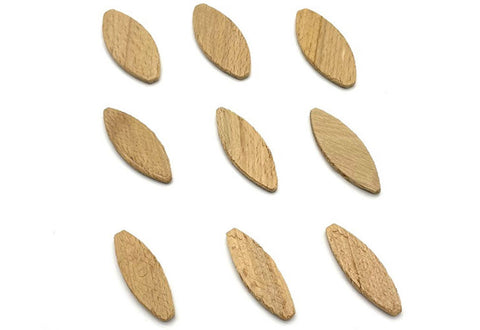
A biscuit joiner, also known as a plate joiner, is a handy machine to cut a curved slot that accepts small and crescent-shaped pieces of compressed wood, typically beech, to create a reliable and strong joint. It can cut wood beech biscuits of 20, 10, and 0 sizes. This tool consists of a circular saw blade, an adjustable fence, and a base plate.
A biscuit joiner's primary goal is to align components such that two boards fit exactly when assembled. This joinery method works by cutting half-oval slots into the surface of the mating edges of the wooden pieces that take compressed wood biscuits. Insert oval-shaped wooden biscuits into these slots, and then glue and clamp the joint tightly until the glue dries. This tight and seamless connection is ideal for manufactured materials, such as MDF and plywood.
A slot that is slightly wider than half of its width is needed. While allowing for some flexibility, this area makes sure that roughly half is left on either side of the joint.
It’s the most efficient way to create a biscuit joint. A biscuit joiner can be a useful tool for better face registration during the glue-up of bigger panels or tabletops, reducing the need for post-glue leveling. They can provide assistance and strength to the joint, but they are not as durable as other joinery, like mortise and tenon.
Biscuit joiners are widely used in woodworking, such as for making cabinets, bookshelves, and tabletops. Due to the stronger joint, they perform better in edge-to-edge, end-to-edge, or end-to-end joining.
Pros:
- Precise panel alignment and stability: Its ability to align and reinforce joints allows for accurate and seamless joints.
- Versatility: It can be used to create edge-to-edge joints, miter joints, and even corner joints. This adaptability makes biscuit joinery suitable for multiple woodworking projects, including furniture construction, cabinet construction, and general carpentry.
- Quick and easy to use: Its simplicity and ease of use make it ideal for newcomers or those searching for a quick and efficient joinery solution.
Cons:
- Weak joint strength: High joint strength applications might not be a good fit for biscuit joinery. Biscuits are pretty thin, brittle, and flimsy; even if they're filled with glue, they absorb the glue and break very easily. The biscuits' size restricts the joint's total strength, which makes it better suited for lighter-duty applications and may not be suited for heavy-duty loads.
- Limited effective uses: An obvious downside is that a biscuit joiner is limited in what it can accomplish. They have limited joint depth and are suitable only for wood surfaces with limited contact space.
What is a Domino Joiner?
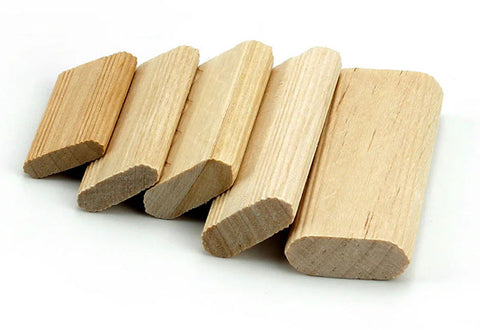
A domino refers to a specialized joinery system developed by the company Festool has gained a reputation for precision and efficiency. The Festool domino is a power tool designed for mortise and tenon joinery. Unlike traditional mortise and tenon joinery, the domino acts as a floating tenon and employs a specialized tool that cuts rectangular holes into the workpieces.
Cut the mortise, and then create domino tenons on the ends of adjacent pieces, which can be precisely fitted into the corresponding mortises. Next, tighten them with glue, resulting in a seamless and solid joint.
The domino simplifies the process of creating mortise and tenon joints, which can make perfect mortise and tenon joints effortless in a short time and increase strength and alignment.
Woodworkers prefer to use domino joinery, especially in making furniture, such as cabinets, face frames, picture frames, doors, and other furniture pieces that require precise and strong joints.
Pros:
- Strength and durability: It is a loose mortise and tenon joinery that is extremely strong and durable, as everybody knows mortise and tenon an exceptionally strong joints; this is just a much faster version of the mortise and tenon.
- The surface area for the glue: The domino has a larger surface and greater glue area in comparison to the biscuits.
- Adjustable depth and width: Domino can also be easily adjusted to cut at different angles to cut into the face of a board, and they are available in many sizes, lengths, and widths, and can be used for both light-duty and large-scale constructions. You can use different thicknesses depending on the size of the material you’re joining together, and cut at different depths depending on the length of the domino you choose to use.
- Enhances speed in production: When creating mortise and tenon joints, the domino joiner takes a lot less time and work than traditional methods. It makes the procedure easier by allowing the cutting of tenons and mortises to be done in a single operation.
Cons:
- Expensive: The Festool domino is a professional-grade tool, and dominoes would give you a little more structural value and work well as loose tenons for breadboard applications and other loose tenon joinery. But there is a price for that convenience.
Sum Up
In conclusion, we had a careful look at the difference between biscuit joiner and domino from their features, functions, and applications. Both joinery tools are designed to do the same thing - insert a small piece of wood into two boards to join them together, but there are some distinctions.
The biscuit joiner is known for its versatility, affordability, and ease of use. Compared to some alternatives, biscuit joiners are a better choice for excellent results. If you are going for alignment, such as with table tops, a biscuit joiner will give you perfect vertical alignment quickly and effortlessly.
On the other hand, the domino excels in precision, speed, and strength. If you’re building woodworking projects that require structural integrity or have strict requirements for precision and accuracy, the domino is worth the price.
FindBuyTool provides industrial-grade router bits and cutters for Festool domino tenons and beech wood biscuits. Whether you need precision, speed, or budget-friendliness, we are your wise choice.
In the end, if you still have any questions about these two joints, leave a comment below, and we will reply to you via email ASAP! Hope this blog will give you a full understanding of them and help improve your woodworking techniques.
FAQ about Biscuit joiner vs Domino
#1 Which is better, a biscuit joiner or a domino joiner?
The biscuit joiner is known for its versatility, affordability. On the other hand, the domino excels in precision, speed, and strength. If you pursue precision, the domino joiner is better.
#2 Is the Festool Domino a biscuit joiner?
It's not. They have some differences, such as shapes. The biscuit joiner is oval-shaped, while the Domino is rectangular-shaped.


