

Dadoes, rabbets, and grooves are three common joints used in woodworking. They have distinct orientations and constructions, but serve to enhance the structure's strength. They are also preferred for making cabinets, boxes, drawers, and bookcases.
In this blog, we will show you the difference between them, applications, and how to use the router table, handheld router, and table saw to cut them. Hope you will have a full understanding of this technique and apply it to your projects.
Differences Between a Dado, Groove, and Rabbet
Dado
A dado, also known as housing, is a prevalent choice for creating strong connections between vertical and horizontal components. A dado is a slot cut across the grain and has a U-shaped channel with a square bottom. It is a groove in the middle of the board. Dadoes are frequently positioned at a specified distance from the board’s end.
Dado joints are a go-to method for establishing reliable and precise joinery, whether it is for bookshelves or cabinets. This joint enables the insertion of shelves or panels into a slot, resulting in a stable and seamless construction. It’s used in many different wood joints such as cabinet shelves, bookshelves, tables, drawers, tables, and animal fences.
Rabbet
A rabbet is an L-shaped channel cut (against and along the grain of the wood) on a board’s face (edge), or end; the tongue is the extruding portion. So there are usually two channels making rabbet joints: edge rabbet and end rabbet. Rabbet joints allow for both interlocking and sliding.
When a rabbet runs across the grain, it’s commonly used for drawer construction, while when a rabbet is cut with the grain, it’s commonly employed for backing on furniture like a bookcase and wall cabinets. In addition to the above, because of the sliding motion of rabbet joints, it’s possible to utilize another block as a lid for a variety of storage furniture pieces.
Groove
A groove is a channel that runs the length of the grain and has three surfaces (two parallel sides and a bottom). A dado and a rabbet are both essentially a groove, while a dado is a groove that has a three-sided cut in the middle of a board like a left side, a right side, and the bottom, but it runs against the grain of the wood instead of with it, and a rabbet is on the edge or end of a board with one shoulder and a bottom.
Grooves are typically used in corner joints and have narrow and long channels carved along the surface of a piece of wood, allowing for the insertion of panels, splines, or other ornamental features. While simple to make, they are not very strong and appear pretty excellent visually. They are commonly found in tabletops, cabinet backs, and door frames, providing strength and flexibility in assembly.
As has been demonstrated, in most cases, these joints are made to be able to accommodate another piece of wood, and these joints can create incredibly strong and functional joinery when a piece of wood is glued into one of them.
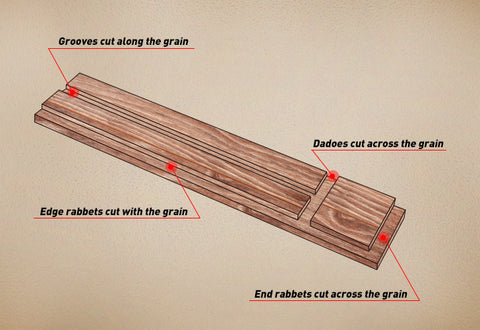
However, compared to rabbets, dadoes and grooves are much stronger in that they have two shoulders, and they can completely enclose the connecting boards. Furthermore, a dado, rabbet, or groove joint may have a different slot.
In general, there are three types of slots: a stopped slot, a through slot, and a mortise. A through slot is cut from one end to the other end of the board, a stopped slot is cut from one end but stops after a distance without reaching the other end, and a mortise is a slot cut in the center of the wooden objects. Depending on the kind of slot that is needed, different machines will be employed to cut the slots.
How to Make a Dado, Groove, and Rabbet
Different woodworking projects will require different steps to make dadoes, rabbets, and grooves. There are three main methods for making rabbets, dadoes, and grooves: table saw, handheld router, and router table.
The ideal way to cut rabbets and dadoes is with a machine; however, conventional hand tools can still be employed. It’s recommended to cut a slot in a dado joint with the help of a table saw.
In situations when cutting dadoes across the sides of a bookcase or cabinet, or in any other circumstance where the work item is too large or cumbersome to push over a table saw or router table, a hand-held router works best.
For a rabbet joint, some simple tools like table saws, rabbet planes, or a rabbet router bit can create ideal results for this joint. Similar to making a dado, a groove cut can also be done with a table saw or a router.
You should now be able to differentiate these types of joinery well enough to decide which you need to add to your workpiece in the near term.
If the cut is close to the edge of the wooden block, the groove can be milled with a slot-cutting bit so that the material is perpendicular to the fence. In addition, it is necessary to use a straight or spiral bit and run the material horizontally on the table if the groove is more than about an inch from the edge of the material.
To decide which option is best for you, you can consider the wood’s properties and the tools you have available. Findbuytool offers a full range of top-quality straight router bits, spiral router bits, and rabbet bits for your woodworking joints. Please contact us for more guidance, or visit our router bit product page to acquire further information.
If you still have any questions about these three joints or our blog, please leave a comment with an available email, and we will reply to you ASAP!
FAQ about Dadoes, Rabbets, and Grooves
#1 What is a dado vs rabbet vs groove?
A dado is a slot cut across the grain and has a U-shaped channel with a square bottom; a rabbet is an L-shaped channel cut against and along the grain of the wood; a groove is a channel cut with the grain. They are three common joints used in making cabinets, boxes, drawers, and bookcases.
#2 What's the difference a dado and rabbet?
A dado features a U-shaped, square-bottomed channel cut across the grain in the middle of the board, used in many different wood joints such as cabinet shelves, bookshelves, tables, drawers, tables, and animal fences.
A rabbet features an L-shaped groove and cut against and along the grain of the wood on a board’s face (edge), or end, used in backing on furniture like a bookcase and wall cabinets.


